Today: Background on DALY health outcomes
Disability-Adjusted Life Years
Learning Objectives
01
02
Friday: Tips and tricks for modeling DALYs in Amua
Overview of DALY Outcomes
01
Summary
- DALYs not as frequently used in HTAs or CEAs.
- Used for resource allocation in LMICs, but with sparse methodological guidance.
- Exceptions: Fox-Rushby and Hanson (2001) , Larson (2013), and Sassi (2006).
- Our methods replicate each: Link to workbook.
Common Outcomes
- Occupancy-based payoffs:
- Utility/DALY weight applied for a time period / step.
- Treatment/disease cost per time period / step.
- Transition-based payoffs:
- One-time event-based cost (e.g., disease-related death, initial Dx, etc.).
- One-time health outcome (e.g., years of life lost to premature mortality)
Disability-Adjusted Life Years (DALYs)
- Reflect both occupancy- and transition-based payoffs.
- There’s also very little guidance on how to structure a decision model for DALY outcomes.
- We’ll show you how this week!
DALYs
Origin story: Global Burden of Disease Study
Deliberately a measure of health, not welfare/utility
Similar to QALYs, two dimensions of interest:
Length of life (differences in life expectancy)
Quality of life (measured by disability weight)
DALYs
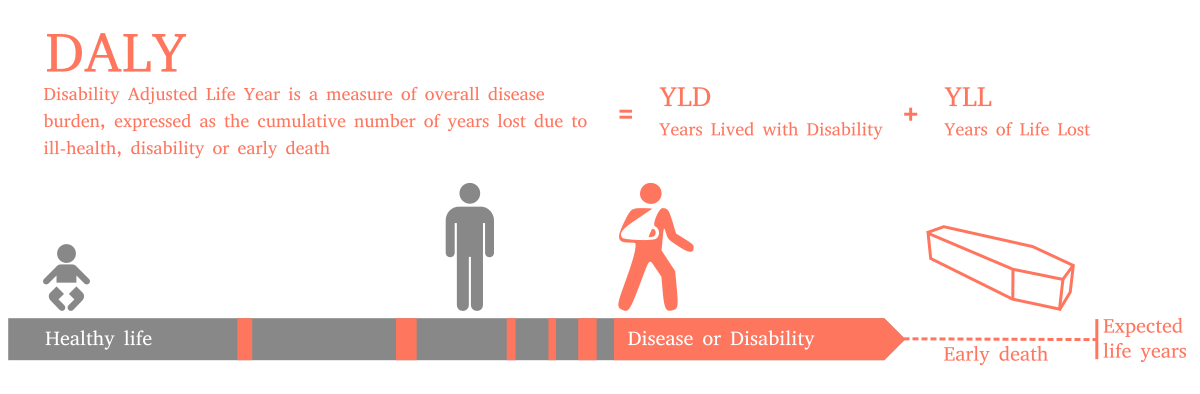
DALYs = YLL + YLD
- YLL (Years of Life Lost)
- YLD (Years Lived with Disability)
Years of Life Lost to Disease
For a given condition c,
YLD(c) = D_c \cdot L_c
- D_c is the condition’s disability weight
- L_c is the time lived with the disease.
Years of Life Lost to Premature Mortality
Years of Life Lost to Premature Mortality
- YLL are defined by by a “loss function.”
- Drawn from a reference life table, indicating remaining life expectancy at age a.
- YLL(a)= Ex(a)
Life Expectancy & YLL
- Contextual Choices: Remaining life expectancy values may vary by research context (Anand and Reddy 2019).
- Historical Method: GBD uses an exogenous life table approximating maximum human lifespan.
- Alternatives: Endogenous tables or models may be preferred in certain cases.
Exogenous vs. Endogenous Life Tables
- Distinction: Source of life expectancy values (external vs. internal).
- Exogenous: Independent mortality risks, using GBD’s reference table.
- Endogenous: Specific to the population’s mortality risks and health states.
DALYs
DALY(c,a) = YLD(c) + YLL(a)
Evolution of DALY Calculations
- Historical Practice: Initial GBD studies applied age-weighting and 3% annual time discounting.
- Changes Post-2010: Discontinuation of these practices for a more descriptive DALY measure.
Current Discounting Practices
- WHO-CHOICE: Time discounting of health outcomes.
Key Takeaways
Modeling Without Discounting
- Modeling DALYs in Amua is straightforward if you don’t use discounting.
- For YLDs, use disability weight like you would a utility weight.
- For YLLs, use one-time “cost” of remaining life expectancy.
- YLL = tbl_reference_life_table[initial_age + t, 1]
Key Takeaways
Modeling With Discounting
- But if you do need to discount …
- You’re going to see some math expressions that take care of discounting for YLL outcomes.
- This math adds some complexity but not much insight, so we won’t belabor it in slides.
- We’ll provide you the formulas to use here and in the .amua model file on Friday.
Thanks!
References
Anand, Sudhir, and Sanjay G. Reddy. 2019. “The Construction of the DALY: Implications and Anomalies.” SSRN Electronic Journal. https://doi.org/10.2139/ssrn.3451311.
Fox-Rushby, Ja, and K Hanson. 2001. “Calculating and Presenting Disability Adjusted Life Years (DALYs) in Cost-Effectiveness Analysis.” Health Policy and Planning 16 (3): 326–31. https://doi.org/10.1093/heapol/16.3.326.
Larson, Bruce A. 2013. “Calculating Disability-Adjusted-Life-Years Lost (DALYs) in Discrete-Time.” Cost Effectiveness and Resource Allocation 11 (1): 1–6.
Sassi, Franco. 2006. “Calculating QALYs, Comparing QALY and DALY Calculations.” Health Policy and Planning 21 (5): 402–8.